



Trade ‘cool’ city check-ins for soulful villages encounters where mountains, rivers and old stones still remember your name.
New Year bucket lists are already filling up with the usual suspects: neon skylines, over-loved party beaches and “Instagrammable” city corners that now look identical from Tokyo to Tulum. Yet the real magic of travel in 2025 lives far from airport billboards, in villages where church bells echo off cliffs, prayer flags snap in icy winds and the night sky still belongs to the stars. This is an editorial love letter to those places and an invitation to choose them over the next over-hyped town break.

Why villages, why now ?
Villages slow you down in the best possible way, replacing queueing for attractions with walks past wooden chalets, local bakeries and fields that dictate the rhythm of the day.
Economically, choosing smaller settlements keeps money in fragile local ecosystems from homestays and family cafés to guides who know every trail and story by heart.
In a climate-conscious era, fewer crowds mean lighter footprints on landscapes that cannot absorb mass tourism the way capital cities can, protecting waterfalls, meadows and medieval streets for the next generation.





Portraits of a different kind of “cool”
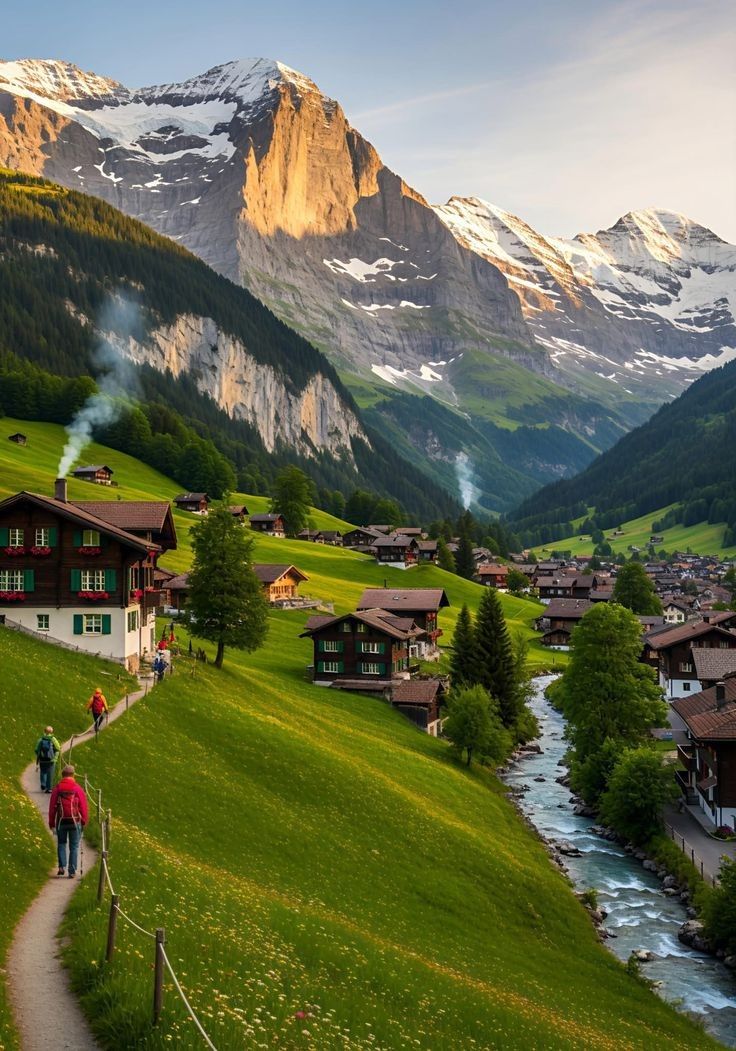
In Lauterbrunnen, Switzerland, 72 waterfalls carve silver threads down sheer cliffs while a modest church steeple anchors a valley that feels carved out of a storybook. The village is small enough to cross on foot, yet vast in sensation: cowbells, the thunder of Staubbach Falls and trains vanishing into the mountains towards Mürren and Wengen.



Grindelwald, Switzerland trades nightclub noise for the hush of snow, wooden chalets circling a glowing village square under the north face of the Eiger. Winter evenings feel like a film set: sledges parked outside homes, streets lit in amber, and mountains so close they become characters in every photograph.
On Austria’s Hallstätter See, Hallstatt leans into the water like a whispered secret—alleyways of pastel houses, a lakeside church spire and reflections that turn dawn and dusk into twin performances. Yet behind the picture-postcard exterior are salt-mining histories, cemetery rituals and lakeside walks that reward those who stay long after the day-trippers leave.
In Ushguli, Georgia, the highest continuously inhabited village in Europe, Svan stone towers rise against the Caucasus like exclamation marks from another century. Winters cut the village off for months, but life goes on: horses in snowy lanes, woodsmoke, and families who have read the mountains longer than any map.
Mont-Saint-Michel, France is technically an island commune, but it behaves like a village, its steep lanes spiralling around an illuminated abbey that floats between sea and sky. Arrive at dusk instead of midday, and the tide, bells and sea breeze create a private theatre that no city plaza can rival.
In the hills of Tuscany, Monteriggioni, Italy is a fortified circle of stone, its walls largely unchanged since the 13th century. Step through the gate and the world shrinks to a piazza, a few trattorias and cobbled lanes where the only rush is catching the last light on the ramparts.
Rocca Imperiale and Calcata, Italy cling dramatically to their hillsides, lit at night like constellations fallen onto rock. Here, life is measured in espresso refills, church festivals and conversations spilling from doorways, not in city timetables.
Bourtange in the Netherlands and Aitoliko in Greece prove villages can be as architecturally daring as any metropolis: one a star-shaped fortress settlement surrounded by moats, the other an islet town stitched to the mainland by slender causeways. Both are masterclasses in how communities adapt to water, trading glass towers for geometric ramparts and fishing boats
From Castle Combe in England to Bernkastel-Kues in Germany, timbered facades and cobbled streets glow under winter markets, offering hot chocolate, brass bands and the feeling of walking through an illustration, not a shopping mall.
In Scandinavia, Reine in Norway’s Lofoten Islands, Gullholmen in Sweden and Tjørnuvík in the Faroe Islands scatter red and white houses along sharp fjords and stormy bays. Fish-drying racks, boathouses and weather-beaten churches remind travellers that these landscapes are workplaces first, postcards second.
Ogimachi in Shirakawa-gō and Yoshinoyama in Japan frame another rural dream: steep thatched gasshō-zukuri farmhouses piled with snow, or autumn hillsides blazing with maple and cedar under the watchful presence of Mount Yoshino. Night falls, lanterns light up the eaves and the line between village and fairy tale disappears.
In Transylvania, Biertan, Romania encircles its fortified church with a ring of homes and snowy lanes that feel frozen in a quieter century. This is not a place for club-hopping; it is for tracing ramparts at blue hour and listening for the echo of steps on stone.
And then there are the Indian Himalayas, where Anini village in Arunachal Pradesh might be one of the last true frontier landscapes left on the subcontinent. Encircled by the emerald Dibang Valley, cloud forests and the culture of the Idu Mishmi people, Anini is still more handwritten letter than brochure: Dri and Mathun valleys, grasslands like Emuli, and waterfalls that require treks instead of tickets.
How travellers can choose villages over “it” towns
- Redefine your wish list. Instead of nightlife and shopping, prioritise silence, walking, traditional architecture and landscape criteria that naturally point you towards mountain hamlets, lake settlements and island communes.
- Travel deeper, not wider. Pick one region say, the Swiss Bernese Oberland or India’s Dibang Valley and base yourself in a single village for several days, using it as a hub for hikes, day trips and conversations rather than rushing between cities.
- Seek local infrastructure. Look for homestays, village-run guest houses, community guides and small tour operators; in Anini, for example, local stays and guides open doors to Chigu, Emuli grasslands and traditional Idu Mishmi homes that no big chain hotel can replicate.
- Travel off-season. Winter in Grindelwald, Hallstatt or Castle Combe strips away crowds and adds snow, markets and long, luminous evenings, while shoulder seasons in places like Reine or Bourtange reveal daily life beyond peak-tourist theatre.
- Stay curious and respectful. Rural communities are not lifestyle props; they are living cultures with their own rhythms, boundaries and sacred spaces, from Svan towers in Ushguli to monasteries near Mont-Saint-Michel and clan rituals in Anini.
This New Year, the choice is stark: another countdown in a city that barely notices you were there, or a lantern-lit lane where one night is enough for the baker, the innkeeper and the bus driver to remember your face. Book the train that stops one station before the famous town, follow the road that disappears into the hills, and let a village whether in Arunachal’s mist, Georgia’s snow or Switzerland’s valley light rewrite what “cool” travel means for you.





Leave a Reply